Transformed advisor-assisted options trading into a scalable self-serve investing capability
A platform gap that created risk, friction, and operational cost
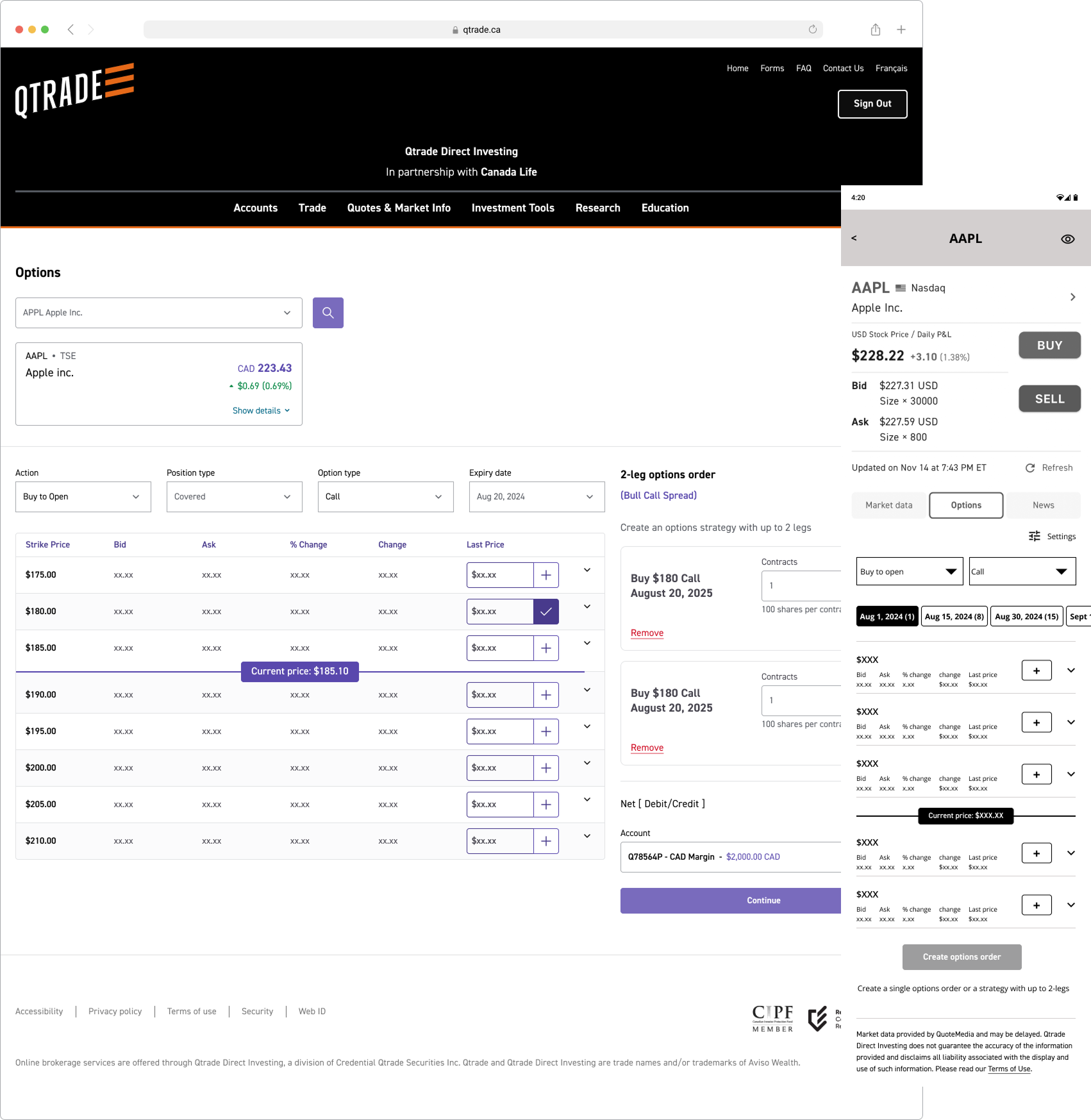
Qtrade supported only single-leg options trading through a basic order form. Investors placing multi-leg strategies had to call the Service Centre, creating a fragmented experience across product and operations.
- Advanced traders could not execute strategies independently
- Service Centre teams manually placed complex trades
- Manual workflows introduced delays and execution errors
- The platform lacked expected tools like an options chain and strategy builder
This was not just a missing feature. It was a platform limitation that prevented Qtrade from supporting more advanced trading behaviour at scale.
Objective
- Enable self-serve multi-leg options trading
- Reduce operational dependency on Service Centre workflows
- Prevent high-cost order entry errors
- Support experienced traders without overwhelming others
- Design a scalable foundation for future trading capabilities
My role
I led the design of a new trading capability, defining the workflow, interaction model, and scalable architecture across product, engineering, and trading stakeholders.
Understanding the system before designing the interface
This problem required understanding trading behaviour, internal workflows, and system constraints before designing screens.
- Interviewed Service Centre reps to understand manual trade execution
- Worked with trading SMEs to identify key strategies and constraints
- Mapped internal systems that were not built for multi-leg logic
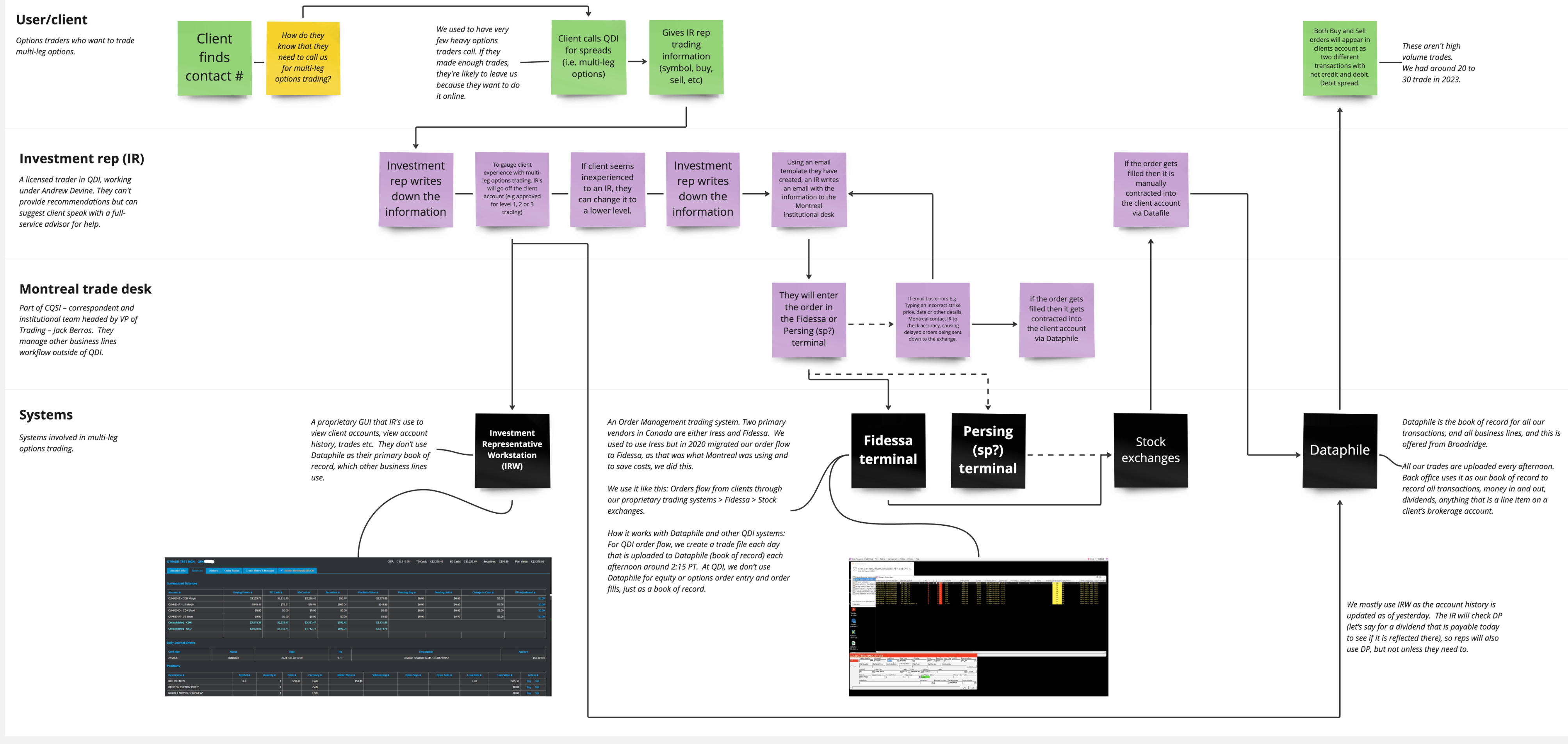
Mapping internal workflows revealed where the product needed to replace operational dependency.
Mapping the trading workflow
I mapped the end-to-end task flow to understand how traders build and validate a strategy.
- Identified key decision points and error risks
- Aligned teams around the actual trading workflow
- Separated UI decisions from system constraints

Designing the interaction model
The core challenge was not designing an interface, but structuring a trading workflow that could support complex strategies while reducing risk and scaling across future capabilities.
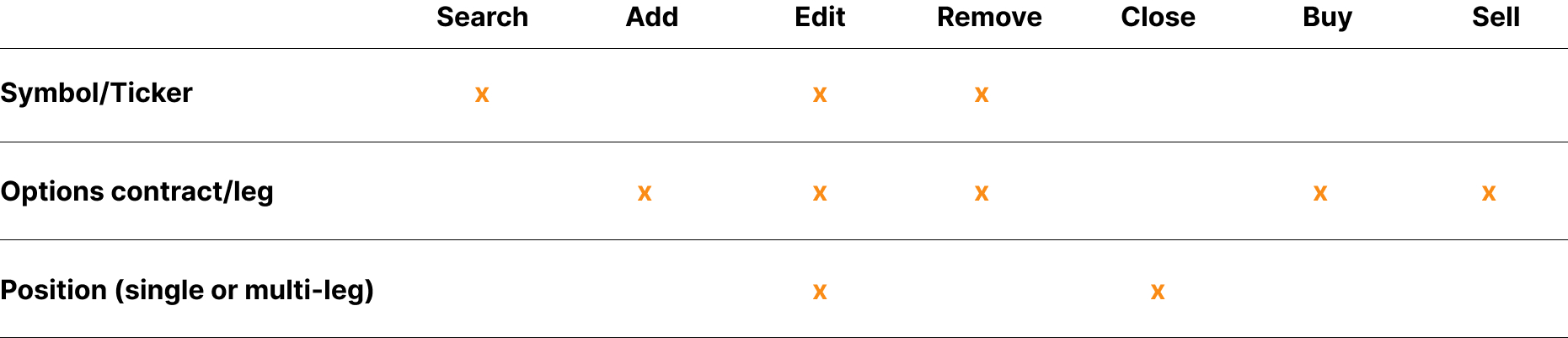
- Used an object-action model to structure the experience
- Designed a modular system for building strategies leg-by-leg
- Created a real-time feedback loop through a live strategy summary
Key design decisions and tradeoffs
- Structured flexibility over full customization: Guided leg-by-leg construction reduced errors while maintaining control
- Options chain as primary input: Selecting contracts directly reduced manual entry and aligned with trader expectations
- Deferred advanced analytics: Excluded P&L graphs initially due to system constraints, focusing on order accuracy first
- Scalable architecture over MVP simplicity: Designed for 4-leg strategies even though MVP supported only 2
Designing for confidence in high-risk decisions
This was also a behavioural design problem. The interface needed to support fast decisions without encouraging mistakes.
- Progressive disclosure: Reduced cognitive overload
- Feedback loops: Live strategy updates reinforced accuracy
- Error prevention: Reduced reliance on manual entry
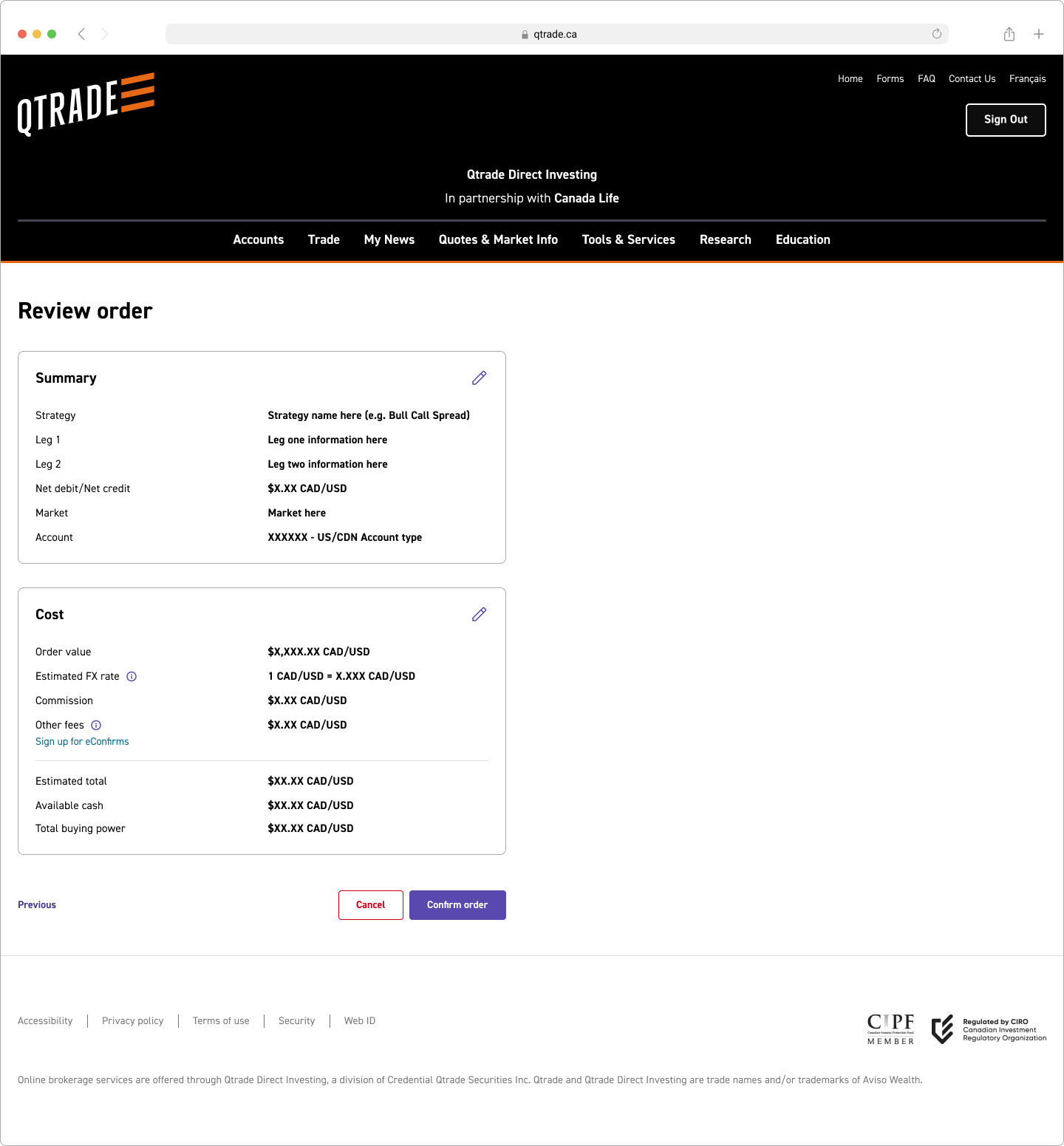
- Review before commitment: Encouraged deliberate verification
Impact
- Enabled Qtrade’s first self-serve multi-leg trading capability
- Reduced reliance on manual Service Centre workflows
- Reduced order entry errors in a high-risk financial workflow
- Shifted complex trading from operational dependency to product capability
- Established a scalable foundation for future trading features
This work helped transition Qtrade from a service-supported trading model to a more scalable product-driven experience.
Back to top